| Day | Timing |
|---|---|
| Monday | 10:00 am – 5:00 pm |
| Tuesday | 10:00 am – 5:00 pm |
| Wedesday | 10:00 am – 5:00 pm |
| Thursday | 10:00 am – 5:00 pm |
| Friday | Closed |
| Saturday | 10:00 am – 5:00 pm |
| Sunday | 10:00 am – 5:00 pm |
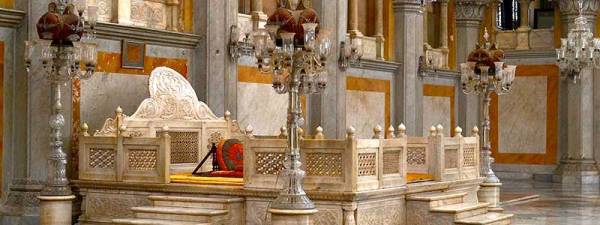
Grandeur of rulers, glory of its past, glimpse of their enigmatic way of living, are still alive in the form of palaces like Chowmahalla Palace, a place worth visiting when on a Pack and move
Built in the 18th century, almost 200 years ago, the Chowmahalla Palace is one of the popular site seeing places. The literal meaning of this place is “Four Palaces” with “Chow” means four in Urdu and “Mahalat” which is the plural of “Mahalel” meaning palaces. Chowmahalla palace is said to resemble Shah Palace of Tehran in Iran.
Chowmahalla Palace History
The construction of Chowmahalla Palace was mainly completed between 1857 to 1869 during the rule of fifth Nizam, Afzar-ud-Daulah, Asaf Jav V. However, its building is mostly credited to Nizam Salabat Jang in 1790. The Palace originally covered 45 acres which extended from the Laad Bazaron the north to the Aspan Chowk Road on the south. Now, the total remained area of the palace is close to 12 acres.
The palace was restored by the Government and was opened to the public in the year of 2005. One can visit the palace throughout the week except on Friday and national holidays.
Source link:https://en.wikipedia.org/wiki/Chowmahalla_Palace
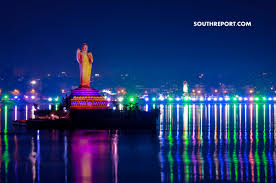
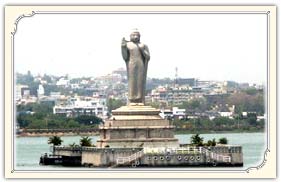 The Hussain Sagar Lake is one of the popular landmarks and important tourist destinations in the city of Hyderabad. Hussain Sagar Lake, situated about 2 km from the heart of the city of Hyderabad, connects Secunderabad to Hyderabad. The Hussain Sagar Lake of Hyderabad is the largest artificial lake in Asia. This lake was built during the reign of Ibrahim Quli Qutub Shah by Hussain Shah Wali in 1562 AD. Hussain Sagar Lake, built on the tributary of the River Musi, had been of significance in the early days since it connected the twin cities of Hyderabad and Secunderabad. The best time to visit the Hussain Sagar Lake and Hyderabad is from October to March, as the weather is pleasing, unlike summers which are likely to get very hot and humid. The lake is open to public on all days (except Mondays) and time. Read further to know more about the lake. The place where the Hussain Sagar Lake is located is called ‘Tank Bund’. It is an abridged version of its actual area and has attained lovely trimmings and environs that augment its appeal to tourists as well as the residents of the twin cities. The lake doubles up as an important landmark as well as picnic and recreation spot. The lake is bordered by four major sections of green space, Indira Gandhi Park in the east, Sanjeevaiah Park in the north, Lumbini Park in the south and a green belt stretch squeezed in between the Raj Bhavan road and the Necklace Road in the west.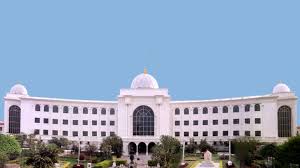
 Brief History and Evolution of the Museum:The Salar Jung Museum of Hyderabad is a repository of the artistic achievements of diverse European, Asian and Far Eastern countries of the world. The major portion of this collection was acquired by Nawab Mir Yousuf Ali Khan popularly known as Salar Jung III. The zeal for acquiring art objects continued as a family tradition for three generations of Salar Jungs. In 1914, Salar Jung III, after having relinquished the post of Prime Minister to H.E.H., the Nizam VII, Nawab Mir Osman Ali Khan, devoted rest of his entire life in collecting and enriching the treasures of art and literature till he lived. The precious and rare art objects collected by him for a period of over forty years, find place in the portals of the Salar Jung Museum, as rare to very rare pieces of art.After the demise of Salar Jung-III, the vast collection of precious art objects and his Library which were housed in “Dewan-Deodi” the ancestral palace of the Salar Jungs, the desirability of organizing a Museum out of the Nawab’s collection dawned quite soon and Sri M.K. Velodi, the then Chief Civil Administrator of the Hyderabad State approached Dr.James Cousins a well known art critic, to organize the various objects of art and curios which were lying scattered in different palaces of Salar Jung III to form a Museum.With a view to perpetuate the name of Salar Jung as a world renowned art connoisseur, the Salar Jung Museum was brought in to existence and was opened to the public by Pandit Jawaharlal Nehru, the then Prime Minister of India on 16th December, 1951.However, the administration of the Museum continued to be vested in the Salar Jung Estate Committee till 1958. Thereafter, the heirs of Salar Jung Bahadur graciously agreed to donate the entire collection to the Government of India through a Compromise Deed based on a High Court Decree on 26th December l958. The Museum continued to be administered directly by the Government of India till 1961. Through an Act of Parliament (Act of 26 of 1961) the Salar Jung Museum with its Library was declared to be an Institution of National Importance. The administration was entrusted to an Autonomous Board of Trustees with the Governor of Andhra Pradesh as its Ex-officio Chairman and ten other members representing the Government of India, the State of Andhra Pradesh, Osmania University and one from the family of Salar Jungs. Nawab Mir Yousuf Ali Khan Bahadur Salar Jung – IIIThe Salar Jung’s family has a glorious past with great qualities of statesmanship for generations and rich contributions from the family towards the vast collection of art objects, manuscripts and printed books, which now find a place in the museum.It is evident that the treasures which the last Salar Jung inherited only added to the vast acquisitions which Salar Jung III made, that too with the zeal of a real collector. This went on for forty years till he passed away on 2nd March, 1949. The then Military Governor declared a public holiday as a mark of respect to this great man, who was a premier noble and Ex-Prime Minister of the old order. The Hyderabad Art Society convened a meeting and passed a resolution of condolence. The Society also resolved that a Museum be opened associated with his name. Location:The present museum building was constructed on the southern bank of River Musi, which is in close proximity to the important monuments of old city of Hyderabad like the historic Charminar, Mecca Masjid etc. The collections of the Museum and the library were transferred from Dewan Deodi to the new building in the year 1968, and two more buildings were added in the year 2000. Collection of Objects:The Museum has a magnificent global collection of art objects and antiques not only of Indian origin, but mostly from countries Western, a sizable collection hails from Middle Eastern and Far Eastern origins. Apart from these, there is a Children’s section, a rich reference library which contains reference books, large collection of rare manuscripts etc. Thus, this Museum has become popular, not only as a place of interest but also as an institution for education.Out of the several rare objects, one of the important and interesting object collected by Salar Jung I was “Vellied Rebecca” an enchanting marble statue which was acquired by him from Rome in 1876 during his visit to Italy. The western collection are from England, Ireland, France, Belgium, Italy, Germany. A set of Ivory chairs said to have been presented by Louis XVI of France to Tippu Sultan of Mysore deserve special mention. A jade book-stand “Rehal” having the name of ‘Shamsuddin Altamish’, an archer’s ring inscribed with the legend Sahib-e-Quran-e-Sani, title of the Mughal Emperor, Shahjahan are masterpieces. A dagger and a fruit knife made in jade decorated with precious stones are said to belong to Jehangir and Noorjehan respectively. A good number of Indian Miniature Paintings in early style of Western India of 14th and 15th Centuries representing Krishna Leela themes are also form part of the Museum’s Collection. There are good number of Arabic and Persian Manuscripts dated to 19th century and Shah-nama by Furadausi are also among the valuable collection of the Museum. A rare manuscript entitled ‘Lilawati” on mathematics and an ancient medical encyclopedia transcribed in India is in the collection. Oil and water paintings form an important part of the European collections. Activities of the Museum:
 PACK AND MOVE